Ruses – Diversions & Distractions

Merriam-Webster partially defines a diversion as – the act or instance of drawing the attention… Merriam-Webster defines distract as – to draw (the sight, mind, or attention) to a different object or compellingly and confusingly attract in divergent directions at once. In this post I’m going to touch on a few different kinds of diversions and distraction devices used by both good guys and bad guys.

As a young police officer in the early 1990’s I was introduced to a technique called the break and rake. What that looked like was me and another officer standing on the back side of a public housing unit with an aluminum baseball bat. The Emergency Response Team (ERT) was stacking up, on the front side of the public housing unit. When advised via the radio our job was to smash a rear residence window followed up by running the baseball bat violently along the four sides of the window frame. All those smaller jagged edges of glass that remained along that window frame made a loud, unnerving, and alarming noise at the rear of the residence. The ‘rake,’ greatly extended the alarm, as it were. Any folks inside would have their full attention focused on whatever problem was unfolding at that back window. As that drama was holding sway the Emergency Response Team used that distraction as an opportunity to breach, enter, and clear by means of the front door. Sometimes an Emergency Response Team chooses to deploy a flash bang which according to Merriam-Webster is – an explosive device that produces a blinding flash of light and a sudden, loud noise intended to temporarily stun, distract, and disperse people. A flash bang is designed to draw one’s attention in a compellingly and confusing way distract and even potentially disorient a person. Think of it like inserting some controlled chaos in order to achieve and maintain order. Causing high levels of stress to physiologically speed up time for the suspected criminal(s) inside the residence so that afterwards he thinks and says something we’ve heard accident and crime victims frequently say: It happened so fast I didn’t have time to do anything. That’s a good goal.

On the other side of the justice fence, unjust ambush predators use a variety of diversions and distractions. Sometimes criminals work in pairs or small groups to distract and then overwhelm an innocent victim. It may be something as simple as having one of the criminals do something odd or do something to cause some anxiety or fear to draw your attention which creates an opportunity for another criminal to approach you from behind (ambush position), and pick your pocket or smack you upside your big dumb head with his pistol then dominate you. Making you do or give him whatever it is he desires. Sometimes ambush predators working together combine other ruses. For instance having a female ask you for the time while her cohort male friend approaches you from your rear (ambush position) – and surprise, speed, and violence of action!

Lone unjust criminal aggressor’s may use some odd type of body language designed to draw your attention to figuring out what the heck you’re seeing. What am I seeing? In hopes of providing concealment for their slight of hand. Their hand slips into their waistline, pocket, or any other concealed area to retrieve their weapon.

To view full YouTube videos please visit my channel at:

https://www.youtube.com/channel/UCluv2DStx7Y5PxEUiwzkO6Q/videos

Where there is one, there are two (sometimes more):

I’ll share a personal story that is a little humbling. It’s been my experience that we have the greatest opportunity to learn far more from our mistakes, from our humiliations, than ten times the number of our successful ‘war’ stories.

When my eldest son was still a little guy, probably five or younger I took him with me to pick up a pizza. It was a cold, dark, evening likely in the fall. The little foyer for pizza pick-up was really small, guessing 20 by 15 feet. During that time of the year at our police department the Armed Robbery Suppression Program was initiated. Twas the season. It was the time of year we’d see an uptick in commercial armed robberies. But what are the odds of that happening to me? So I’m standing off to the side with my son, waiting for my pizza. In walks a white male who begins asking some odd questions about getting some kind of a check cashed. The employee’s tell him no way will that happen. I start getting that feeling, that hunch, that this may be about to spin up into a robbery, and a shooting. I’m off duty carrying a pistol in the 5-6 O’ clock position (backside). My hand creeps back behind me while still trying to look casual (probably failing). Being a young police officer I had not yet learned how and more importantly why I liked my firearm in the 1-2 O’ clock positions. Oh yeah, and because it was the early 1990’s I think it was a snub nose .38, making things a little more awkward. So this odd guy turns and looks directly at me looking me, sizing me up. Like he’s thinking about what comes next. I’m annoyed at myself for having brought my son, and afraid this is going to spin up into a shooting and I don’t want my son anywhere near this small room and these current circumstances. This incident changed how I did things in the future. If I had to up some carryout during armed robbery suppression season – from that point forward I did it alone. Back to this sketchy guy; he turns and walks outside and stops right in front of the door. I’m watching him. Within a second or two, a second white male that I’d never seen steps into the light from around the corner of the building.

  • Was he a look out?
  • Was he waiting for the first guy’s assessment?
  • We’re they still going to rob this business?
  • Had I missed an opportunity to see this second guy with all my attention on the first guy?
  • Why was this second guy staying just out of sight?

What if I’d had to shoot the first guy and spent all five revolver rounds on him? Would I have even known to look towards the front door for a second guy? No, I would not have known before experiencing that.

Far more questions than answers. They have a short friendly conversation. They throw a look back inside towards me and then, they both walk off together. I think I still had my strong side hand behind my back trying to look casual (probably still failing). I’m absolutely relieved that this didn’t spin up into a shooting. At that time our police department had a specific set of dates for the start and end of the Armed Robbery Suppression Program. Later the initiation and conclusion dates were left up to the discretion of bosses based upon what was happening in our community. In general that season – that program – was initiated sometime in October and ran through and into the beginning of the next year. So as a civilian pay closer attention to things like the police beat section of your local newspaper or local television news reporting. When you observe an uptick in commercial armed robberies, begin counter measures. What might those look like? These are common sense suggestions:

  • Transition to delivery October, November, and December
  • If you have to pick up carry out don’t bring along children
  • Spend less time on the “X” – meaning don’t stand around inside go in when you expect it will be ready even if it means arriving a little later to ensure it’s ready to pay, grab, and go
  • Pick up your carry out before the sun sets
  • Patronize businesses with a pick up window
  • Avoid patronizing food places in high crime areas
  • Patronize businesses in smaller towns with lower crime rates for a few months

Think about these things.

Ruses – Disinterested Near Pass

YouTube Capture

Unjust criminal aggressors sometimes act like story tellers. As if we we’re a little child, they tell us a story. Of course the story is a half truth, a lie. They show no interest in you at all, and they adopt a line that appears as if it will come close to you and yours, but not actually intersect. So we’ll call it a near pass.

A convicted felon was recently arrested and charged with the attempted murder, in the ambush shooting of two Los Angeles deputies in Compton. Check out my YouTube channel where I made a video explaining this ambush. Here is a link if you’d like to check out that video.

Following the ambush the Sheriff’s Office held a press conference. LA Sheriff’s Homicide Captain Kent Wegener said this:

“Two deputies from our transit services bureau were parked adjacent to 101 east Palmer in the city of Compton… The suspect approached them from behind as the deputies were facing southbound in their patrol vehicle. The suspect came from the north. He walked along the passenger side of the car. He acted as if he were going to walk past the car. And then he made a left turn directly toward the car, raised a pistol and fired several rounds inside of the vehicle striking both of the sheriff’s deputies. The suspect then fled on foot northbound from the shooting scene and out of view.”

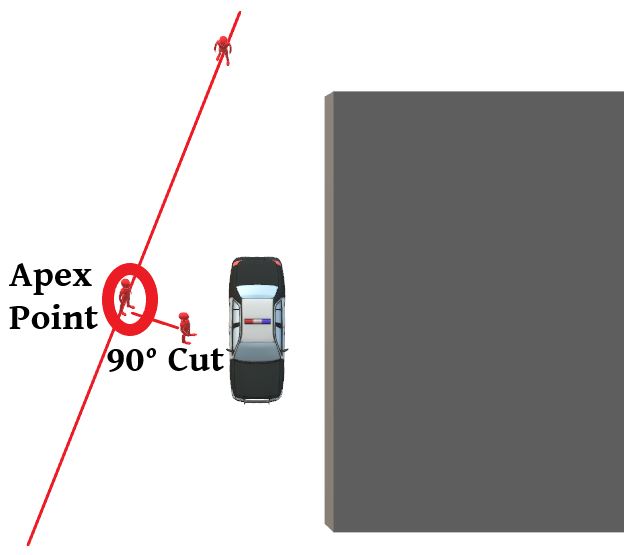
Captain Kent Wegener said the ambush predator “acted as if he were going to walk past the car.” What might that look like? It might look exactly like this:

The ambush predator does not dare glance at his intended target. He seems thoroughly disinterested. Things are not always what they seem. The line he adopts is designed to appear as if he’s passing by with nothing more than a near pass. Think of how we view meteorites passing by the earth. Unlike a meteorite an ambush predator has free will to change directions radically. The ambush predator patiently maintains his course until he reaches that apex point. The apex point is that sweet spot where he has the best tactical opportunity to turn 90° and be within milliseconds or perhaps just two seconds of simultaneously drawing and dominating his intended victim(s), by threat of force or actual force.

The angle of approach isn’t that important. It’s the disinterested near pass that facilitates the opportunity. Those viewing the potential problem might be a little lazy thinking things will probably work out. Until – they – don’t.

What’s a counter ambush tactic to this? Especially for a citizen the best tactic is to just put the car in gear and take a little roll around the parking lot, neighborhood, or wherever you find yourself. ‘But I don’t want to lose this spot!’ Okay, that’s your free will decision. In my opinion it does matter where you are. Probabilities do matter. In a high crime area I’m giving up that spot and taking a little Sunday cruise, as it were.

Another counter ambush tactic for those who may have a responsibility to be parked there monitoring something (like a police officer), is to get out of the vehicle. Vehicles can be like a tomb. We have no real mobility seated in that vehicle. As a police officer I was taught to get out of the vehicle and meet your potential problem on your feet. Why? Mobility gives you the capacity to move – to strafe left or right in relation to any potential threats you may be facing. As seen in the image below the officers could exit and face their potential ambush predator’s left flank. The officers can orient in a kind of a line as seen below or an “L,” shaped positioning, ensuring neither officer is in front of the other as they face the potential threat. This will require a little reconfiguration on the officers part, as the potential threat passes by. That reconfiguration is as easy as walking up to maintain the integrity of that line.

Think about these things.

Ruses – Deception

Ambush predators use deceptions to gain advantages in positioning, timing, and over the will of their enemies. The best working definition for the word ‘tactics’ that I’ve ever heard, came from an Army ranger, John Lovell. John Lovell founded a business called the Warrior Poet Society. On one of his YouTube videos, Lovell explained his definition for tactics as; gaining an advantage in timing, positioning, or psychology. If what he meant by psychology is to gain an advantage over the will of your adversary, then that is an excellent working definition for the word ‘tactics.’ In this post I’m sharing a ruse ambush predators use which includes deception or lies. It is a lie expressed as a plea for some type of help. Relying upon a person’s good will, virtue, or social constructs, the unjust aggressor calls out to a prospective victim asking something like:

“Can I holler at you for a second?”

“Do you have the time?”

“Can I get dollar?”

“Can I get a smoke?”

“Can I get a light?”

In other words: Hey man, could you stand still so I can get close enough to rob, rape, or murder you? I’ll be right there, just hold up. Thanks.

I have to make a distinction here. I’m not saying every beggar, panhandler, or person in need of assistance is a robber, rapist, or murderer. That is absolutely not the case and that is not what I’m saying. I have personally experienced many panhandlers and other folks in need of some assistance, without having any need to exercise a legitimate self-defense. Neither is this statement any kind of false compassion on my part. It is my personal experience that most panhandlers (not all – some are more aggressive than others) even when told “no,” accept it and move on to the next person. In my professional experience victims sometimes report suspects having used one of these type ruses as part of the crime of robbery. As the world grows darker with the darkness of sin these things may change, so you have to pay attention to the circumstances on the ground wherever you live. As things change, and as probabilities increase towards violent encounters, then we ought to commensurately adjust and adapt our tactics to keep ourselves and those we’re responsible for safe and protected.

What I am saying, is where people are robbed, raped, or murdered this type of a ruse is sometimes used. So you have to look to the totality of the circumstances. Where are you? Are you in a high crime area where robberies, rapes, and murders are consistent year to year? Relatively larger police departments often have dedicated websites and provide statistical mapping data showing where homicides and more importantly shootings occur. Why is it more important regarding the shootings? 1) Shootings provide more data points better defining a geographical area as anecdotally there are around ten times the number of shootings as homicides, and 2) shooting related crimes don’t occur in a vacuum. Where you have a lot of illegal shootings and homicides you’ll have robberies, rapes, and other crimes of violence. Is it nighttime? Are you alone? Are you broken down on the side of the road? Are you isolated or is there the potential for cooperating witnesses? Is there an availability of help or assistance? What other factors indicate to you this man approaching is a dangerous man? Does he hold himself out through how he dresses, adorns himself, speaks, or generally comports himself as a dangerous man? Does he have a party spirit? Does he have an angry spirit? Does he have a profane spirit? Does he have a lawless spirit? Does he have as the Bible says an unclean spirit? Have you offered any ambiguity testing by moving in a direction off line with his pathway, and does he readjust to a line intersecting, or a near pass, with you and yours? When you tell him; STOP – GET BACK! Does he obey or disobey that request? Does he continue compressing time, distance, and cover (concealment or obstacle) with you or yours? Context matters.

What purpose does this type of a ruse serve? The lie is used to gain an advantage in positioning. Specifically what position? Point blank range. Why does an ambush predator desire point blank range? The short answer is they need to close the gap in proximity to feign, display, draw, point and/or dominate their victims with whatever weapon they’ve brought to compel compliance of their will. It might be an edged or a blunt weapon. You have to be really close to be able to stab me or hit me on top of the head with a club. It might be a firearm.

Why would an ambush predator need point blank range with a firearm? Prior to having a full year of solo patrol as a young rookie police officer, I was blessed to be assigned into a small specialized unit called NTP (Neighborhood Team Policing). I continued cutting my teeth, as it were, in this unit. In 1991, NTP primarily served the people of the John Hay Homes public housing units in Springfield, Illinois (later torn down). Work consisted primarily in seeking and recovering drugs, guns, and making solid felony and misdemeanor arrests targeting local drug dealers, gang members, and shooters. The onset of crack cocaine and the violence surrounding this was raging in the early 1990’s. Later our team was assigned additional responsibilities of responding to and dealing with other hot spots like Evergreen Terrace and the Brandon public housing units due to upticks in shootings and murders. NTP was later disbanded briefly only to be restarted as GEM (Gang Enforcement Mobile Unit). Later GEM was disbanded only to start up again as SCU (Street Crimes Unit). The responsibilities of targeting and dealing with the worst most dangerous members and most dangerous areas of a community remained the same.

One of my best friends who had also served in NTP just prior to my tenure, told me of an occasion where a drug dealer had cockily asked him if he’d heard about another drug dealer getting shot, as if he [the drug dealer] may have been the shooter. At the time there had been several shootings among drug dealers. My friend told the drug dealer; Yeah you guys need to take some target practice before you try on the role of gunslinger. This was a kind of dig on the accuracy or marksmanship of a drug dealer. This drug dealer told my friend: There ain’t no place to shoot and no extra ammo. You get what you get. Meaning if you steal, or buy, a stolen firearm from a burglary, and that firearm only has (4) rounds of live ammunition in it, then that’s all you get. If you’re living the lifestyle of a drug dealer, gang member, or shooter, you catch things like felony cases and convictions. As a result you are not eligible to purchase firearms nor additional ammunition. What this drug dealer was saying to my friend in it’s essence was;

There are no square ranges in high crime areas, welcoming convicted criminals. There are no professional certified firearms instructors teaching violent criminals and convicted felons how to get better at marksmanship, much less how to get better at combat shooting. It wasn’t worth it to chance going out to some remote location in attempt to learn to shoot – police would likely show up and then they’d have a new problem – a new criminal case. Target practice inside of a high crime area would likewise result in calls to the local police which again increases the probability of catching a new criminal case. Opportunities – were – lacking to get better.

Why does this matter? Because folks who live the lifestyle of a drug dealer, a gang banger, or other dangerous and potentially violent criminal need point blank range, to do what criminals do. They need point blank range to have the composure, confidence, and wherewithal to initiate and dominate you and yours.

To gain point blank range the unjust criminal has to compress time, distance, and cover with you. He has to close the gap in distance. “Can I holler at you for a second?” This type of ruse is one way for an unjust criminal aggressor to close that gap. In essence he uses the voluntary compliance of his targeted victim. That voluntary compliance may be born of an irrational fear of giving offense to another. It would seem things like fraternal corrections have become great secular sins. As if being ‘nice,’ were some kind of virtue. It is not. Being kind – which has to do with a ‘concern for’ an individual is a part of authentic love. Kindness includes things like loud rebukes and when appropriate fraternal corrections. Perhaps this voluntary compliance is born of an irrational fear of being perceived as politically incorrect. Perhaps it is simply born out of ignorance. Regardless, by closing the gap the unjust aggressor is provided with an opportunity to feign, display, point, or use any kind of weapon (edged, blunt, or a firearm) to intimidate or force you to give him whatever he desires. Pointing a firearm at point blank range [say 1-3 yards] gives an ambush predator a shooting platform where it is difficult to miss. The target fills the background of the aimed firearm. The ambush predator often has the element of surprise which also gives him composure. While it’s beyond the scope of this particular post we ought to seek to remove the ambush predator’s opportunity to gain this kind of a shooting platform. We ought to seek to remove his composure by climbing higher up in the proverbial tactical tree where he may see: This person is not low hanging fruit. Where he finds himself exceedingly high and out on the thin limbs that cannot and will not support his weight, as it were.

As Clausewitz partially defined war; coming down to the ‘will’ of men. What does a man desire? Your money, car, body, or your life? It is the threat of great bodily harm or death for which we fight. Sometimes we have to wait our turn, as it were. It’s really hard to draw from the drop. Meaning, if an unjust ambush predator gets the drop on you and is pointing a firearm at you that’s not the time to draw unless he begins shooting – then you’re going to want to simultaneously move strafing left or right, drawing, and shooting. From the drop the prudent play is to wait until he gives us a deep flank or an ambush position – a blind spot. Legitimate self-defense and defense of another with a firearm can never be about vengeance. Vengeance is God’s business, not man’s business. Legitimate self-defense and defense of another with a firearm must remain about responding to an imminent threat (in Illinois) of great bodily harm, or death to you or another. In my opinion it is money well spent to seek out professional training in the statutory language and application of justified uses of force for the state you reside. Consider these things.

O-O-D-A Loop: An Introduction

The late Col. John Boyd USAF, gave the world the O-O-D-A Loop. In Robert Coram’s book Boyd the Fighter Pilot Who Changed the Art of War, Coram writes:

“The OODA Loop is often seen as a simple one-dimensional cycle, where one observes what the enemy is doing, becomes oriented to the enemy action, makes a decision, and then takes an action. This “dumbing down” of a highly complex concept is especially prevalent in the military, where only the explicit part of the Loop is understood.1”

O-O-D-A stands for Observe, Orient, Decide, & Act. Growing up in Law Enforcement which is a quasi military organization, I have learned through experience simple and aggressive are often – a – winning – combination. Under stress we want to keep things simple, perhaps even “dumb things down” a bit. When we’re not under stress then we ought to set about learning that body of knowledge which makes the OODA Loop a bit more complex. Coram goes on to say:

“The key thing to understand about Boyd’s version is not the mechanical cycle itself, but rather the need to execute the cycle in such fashion as to get inside the mind and the decision cycle of the adversary. This means the adversary is dealing with outdated or irrelevant information and thus becomes confused and disoriented and can’t function.2”

I agree with Coram on disrupting the enemy’s mind and again through experience I have learned it comes down to a mans “will.” The adversary always gets a vote. When it cannot be avoided or escaped for a variety of reasons then an innocent defender must forcibly remove the adversary’s hope, his will to continue attacking, or his capacity to continue attacking. By achieving and maintaining relative superiority an adversary rapidly experiences discouragement, giving way to despondency, and despair. Those all have to do with hope. When the unjust aggressor presents a deadly force threat an innocent may achieve this via means of lethal defensive blows oriented towards bringing about a physiological stoppage. If the unjust aggressor should suffer a psychological stoppage meaning he gives up (despair), stops, or flees, then the innocent stop delivering lethal blows. No more lethal blows. What might that look like? He purposely drops the gun, knife, or blunt weapon, and ceases his attack. This is not and cannot be about vengeance. The last Coram excerpt for this post;

“Even Boyd’s acolytes3do not always agree on what Boyd meant with the OODA Loop.4”

I had to look up the word acolyte to figure out it means follower. This problem solving model (that’s what I’m calling it) applies to far more than the topic of legitimate defense of self or others. So if this is a problem solving model, what’s the problem? In legitimate self-defense or defense of others, it’s an unjust aggressor presenting a threat of bodily harm (less than lethal force), great bodily harm (lethal force in Illinois), or death to innocents.

We first have to observe something that concerns us – a potential threat. Then we have to orient (analyze and correctly understand) whether it is a legitimate threat, something requiring more observation & maneuver to avoid, or nothing to worry about at all. Boyd’s work concerning orientation revealed cultural traditions, genetic heritage, new information, previous experiences, and analysis and synthesis all factoring into how a person is going to perceive what they see. Boyd also believed these parts are interconnected. I would add they compenetrate5 one another. Meaning pervade or penetrate throughout. I see Boyd’s cultural traditions and genetic heritage as what I call a persons filter. The filter being the sum total of a persons upbringing, education, religious beliefs (or not), training, and experiences. Their philosophy or world views. All of these have a part to play in how a person perceives what they observe. The important thing to note is by education and training we can build in a trained response. When stressed we often default to our level of training or that trained response. Experience quite literally convinces a man. Experience often raises a mans propensity for violence.

“Experience: that most brutal of teachers…” ― C.S. Lewis

I can attest to the fact that experience will change your mind, providing you live through it. If you believe all people are basically good and that you can trust in everyone’s mercy when the chips are down – you error, you error.

Is there a gap in the orientation stage between reality and a persons perception of reality? A persons perception can be right or it can be wrong. A particular person might buy into things like political correctness or false compassion for robbers, rapists, and murderers. Those errors are going to need to be educated and trained out of that individual so that they observe, orient, decide, and act based upon sound principles and not some social construct that inspires fear, hesitation, and a loss of innocent life. The orientation stage will interconnect with the observation stage as a persons filter has it’s way with a persons perception. The orientation stage will interconnect with the decision making stage as the persons decides correctly or incorrectly based upon their perception. The orientation stage primarily has to do with knowledge. Education, training, and experience can forever alter how we deal with particular problems. Where there is a breakdown in any of these stages things can begin to unravel and as we go through a succession of Loops the end result can be a tragedy. Saint Thomas Aquinas said: An error in the beginning is an error indeed. That’s because the error compounds. That is why it’s more important we get orientation right in the beginning. We can have all the skills in the world and they’ll do us no good if we haven’t yet addressed and dwelt with questions or problems having to do with our perceptions. All of the factors Boyd identified in the orientation stage will impact the decision making stage. We tend to think of just one loop. There are often many loops. We’re going through the loops as well as those around us. Think about how this would apply to something like defensive driving. In defensive driving we’re constantly observing, orienting, deciding, and acting. We’re analyzing and we’re synthesizing changing conditions and new information. Our past driving experiences influence our perception, decisions, and actions. It’s not just one loop! It’s not just one decision! Sometimes multiple decisions come at us at the same time. Then have to prioritize what decision has to be made now and act on that decision. Are we making sound decisions or are we beginning to stack errors? What was a persons training like? Was formation based upon first principles? Was a trained response built in? The real work for preparing a person to make good decisions comes during formation in the orientation stage. It comes from proper education, training, and depending on the line of work experience. The act stage has much to do with skills. This stage also has much to do with the application of the body of knowledge purportedly learned during the orientation stage. Can we put all that together? Can we make it happen, as it were? How competent are we at all that tactical knowledge we ought to have learned during our formation? Do we continue to strive to learn as a student? Do we care enough to learn our craft? Do we care enough to do the work to become a craftsman? The orientation stage has much to do with growing in these competencies. The action stage is where we have to begin applying these things. Nothing less than perfect practice, right? How are our firearms skills? Have we correctly prioritized the four safety rules and then sought out scenario based training to pressure test these safety skills? Can we move and administratively handle a firearm safely for the benefit of any and all innocents nearby? An emphasis ought to be placed on this aspect of firearms handling. The goal is to defend the innocents we’re gravely responsible to protect. We ought to place more of an emphasis on the four safety rules. On a live square range do we have an ability to get our gun working and keep our gun working? Have we grown in competency as it relates to marksmanship? Have we advanced in competency to a combat style of shooting? Some public and private ranges may not permit this type of skill building. Have we continued advancing as it relates to drawing and shooting? Many ranges will not permit drawing from a holster. Do we have an ability to keep the firearm working, meaning have we been educated, trained, and had an opportunity to practice malfunction drills? Have we received education, training, and an opportunity to practice speed loads and tactical loads?

We can begin to see Coram’s assertion that this problem solving model is highly complex. Yet in managing or dealing with unjust aggressors it’s good to keep things simple. So we have to learn all of these things, practice perfectly, grow in wisdom and then strive to keep things simple.

It’s my understanding Boyd believed, the orientation stage was the most important stage. I hope I helped you to see above how and why that is a true statement. If we fail to orient correctly then we’re not going to make right decisions. Going through the OODA Loop at a faster tempo doesn’t really matter if we’re arriving at bad decisions. If the right decision is to shoot an unjust aggressor in defense of self or others, and I come to a conclusion other than that, then I and my people may suffer great bodily harm, or death.

Additionally, there are exchanges that must be considered. There is the moral battlefield which in my opinion is the most important of all the battlefields. Did we do the right thing before God? There’s the physical battlefield – did we consider subject factors, timing, and positioning to name just a few concerns as it relates to winning the physical fight? There’s the legal battlefield which increasingly today seems to be in direct conflict with itself and with the moral and physical fundamental principles of legitimate self-defense. Due to activist prosecutors the legal battlefield seems to be at war with it’s own precedent6 and jurisprudence7. Police and innocent citizens may get indicted unjustly, and even lose their freedom. There’s the civil battlefield – where police and innocent citizens may be litigated into bankruptcy. There is the social battlefield – some special interest group may bear down with an unjust pressure of physical threats, a burning, and destroying. The truth is we have to weigh these things and we must be willing to make exchanges as it relates to risks from one battlefield to another. Sometimes we have to assume higher risks on a particular battlefield so that we might still do that next right thing. The orientation stage includes a large body of knowledge. You cannot and will not, learn that body of knowledge in a 16 hour introductory level course for concealed carry. That is a bare bones introduction. I have identified twelve fundamental principles that I believe are critical to that body of knowledge. Some of these principles contain more than one subject matter and additional principles are contained within. These principles interconnect and compenetrate:

  1. Leadership
  2. Mindset
  3. Problem Solving
  4. Jeopardy Testing
  5. Threat Awareness
  6. Tactical Staging
  7. Time, Distance, Cover (concealment)
  8. Giving Loud Rebuke
  9. Relative Superiority
  10. Surprise, Speed, Violence of Action
  11. Action Beats Reaction
  12. Throttle Control

John Lovell of the Warrior Poet Society, former Army Ranger and professional trainer once gave what I consider a very good working definition of tactics. As I recall he said: Tactics are to gain an advantage in timing, positioning, or psychology. If what he meant by psychology was to gain a tactical advantage over the “will,” of an enemy then that’s the best working definition of tactics I’ve ever heard.

For those who lack knowledge, training, or experience in violence, things will most likely breakdown during the orientation stage, of the O-O-D-A Loop. Why? They can’t give what they don’t have – nemo dat quod non habet meaning no man gives what he does not have. They may see a threat but not perceive it as a threat. They may see a threat, perceive it correctly, though not know what to do about it and freeze. A goofy loop is when a person repeats the same thing over and over seemingly expecting a different result. That’s not a good a plan. I was first introduced to the term goofy loop which came out of a book called Training at the Speed of Life, Volume 1, by Kenneth Murray. For the untrained citizen a goofy loop may sound a lot like pleading; Please don’t kill me. Please, I have children. Please, I’m begging you. No, don’t do it, don’t do it…

For a trained police officer things are going to break down during the decision making stage, of the O-O-D-A Loop. With police officers you’ll hear something like: Drop it! Drop the gun! Drop it right now! I’m not telling you again! Put it down! Put the gun down! That’s a goofy loop. It’s far less likely a police officer will experience a break down in the orientation stage of the OODA Loop due to their training and experience. It could happen, with poor training, or complacency, or a really good ambush sunk in deep. However it is far more likely to occur during the decision making stage. Why? Fear. Fear is at the root of a break down in the decision making stage of an OODA Loop. Fears often flows forth from bad leadership. That may come from the top boss of your organization or it may come from outside; say from an activist local states attorney. It may come from some other politician having influence and the means. For instance say a governor who uses his attorney general and his state police when local authorities deem a case of self-defense to be justified. There are many and various politicians acting unjustly in these dark and crazy days. Many have begun to call good – evil, and call evil – good. Bad or improper training also flows forth from a crisis in leadership. Now-a-days officers have to fear being charged with a crime even when acting rightly in the best interest of innocent citizens, innocent brothers or sisters in arms, and also out of self defense for their own life. Why? Activist local prosecutors who have clogged up filters, as it were. Activist politicians bowing down to the false idols of political correctness. A false compassion or false pity for robbers, rapists, and murderers. We have a crisis of leadership today.

The decision stage will often involve many little decisions. There are often many OODA Loops occurring for all parties involved in a violent confrontation. We want to avoid stacking errors.

The act stage reveals whether you can apply or make happen all that knowledge base gained in studying and building in the trained responses learned in that body of knowledge during your education, training, and experiences – in other words your analysis and synthesis of the orientation stage. Skills matter. This is where we begin to find out through well scripted scenario based training under some artificial pressure (stress inoculation) where the deficiencies are. Or where you might shine. Vetting then getting to work strengthening your weaknesses.

Boyd found that his enemy’s desire to defeat him could be used to lead his enemy into a position of disadvantage. Bill Whittle wrote this regarding John Boyd:

“In the mid to late fifties, a fighter pilot could earn himself a quick forty bucks and perhaps a nice steak dinner in Vegas – not to mention everlasting renown, which is to fighter pilots what oxygen is to us lesser beings – by meeting over the Green Spot at thirty thousand feet and taking position just 500 feet behind an arrogant and unpleasant man with precisely zero air-to-air victories to his credit. From that perfect kill position, you would yell “Fight’s on!” and if that sitting duck in front of you was not on your tail with you in his gun sight in forty seconds flat then you would win the money, the dinner and best of all, the fame. …And yet that forty dollars went uncollected, uncollected for many years against scores of the best fighter pilots in the world. ”

How might that apply in a concealed carry situation? Early on you see a potential threat compressing time and distance with you. So you maneuver away from that threat towards cover. Cover is simply defined as something that will stop bullets. Gaining cover is to gain a position of advantage. If the threat is lethal then we’re going to lean out so that all the unjust aggressor see’s is a slice of our face, our dominant eye, and the muzzle of our firearm. He now finds himself in a place he doesn’t want to be. You crossed an expanse making it to cover. He didn’t make it to cover. He’s big, meaning his whole body is subject to receiving incoming rounds. You’re small, meaning he only has a tiny sliver of your face to target.

An academy instructor at the police agency I retired from used to add a silent little “a” at the end of OODA-“a” which he said stood for accept. Can we accept what’s happening? How quickly can we accept what’s happening? This goes back to the previous post where I wrote about the grief process applying to any bad news: Denial, anger, bargaining, depression, or acceptance. Acceptance is the way around, over, under, or through bad news. Acceptance gives you more options and more time to maneuver, as it were.

As an introduction I’ve said a few things about the O-O-D-A Loop. God willing, in future posts I’ll paint a better picture of this fundamental principle of legitimate self-defense.

1Boyd the Fighter Pilot Who Changed the Art of War, Robert Coram

2 Boyd the Fighter Pilot Who Changed the Art of War, Robert Coram

3 Acolyte: one who attends or assists : FOLLOWER

4 Boyd the Fighter Pilot Who Changed the Art of War, Robert Coram

5 Compenetrate: to penetrate throughout : pervade.

6 Precedent: a judicial decision, a form of proceeding, or course of action that serves as a rule for future determinations in similar or analogous cases

7 Jurisprudence: the science or philosophy of law

Bad News – Five Stages

So here’s my take on how the five stages of grief apply to bad news, crisis, and violent confrontations. It seems our country (and the world) has been getting a lot of bad news lately. I look around my Church, and I look around my country, and I grieve, over what’s been going on low these last many years, months, and days. In this post I’ll do my best to unpack these five stages. I’ll strive to tie it all back to leadership and legitimate firearms defense. This isn’t really my lane, but sometimes you just have to turn the 4X4 knob, and get some mud on the tires.

What are the five stages of grief?

  1. Denial
  2. Anger
  3. Bargaining
  4. Depression
  5. Acceptance

At the end of my law enforcement career I had the privilege of co-leading the Professional Standards Division – Internal Affairs. Along with another Lieutenant, and a good friend, probably the biggest issue we strove to consistently deal with were peoples perceptions. There is reality, and there is often a gap between that objective reality and a man or a woman’s perceptions. When I think of perceptions I can’t help but think about how people have kind of a filter. The late Col John Boyd addressed this idea in his orientation stage of the OODA loop. Boyd’s orientation stage was said to include things like genetic heritage, cultural tradition, previous experience and purportedly Boyd believed the orientation stage was the most important part of the OODA loop since it shapes the way we observe, decide, and act.

So how do I see a persons filter? It is the result of a persons upbringing, the sum total of things like their religious beliefs, education, training, experiences, and their world view. What have they come to believe? What have they come to be convinced about, or not convinced about? These influences help to form how they perceive objective reality. Our challenge in Internal Affairs was to patiently, kindly, yet without watering down the truth one iota – strive to help folks understand why police officers did the things that they had to do. When body camera videos came onto the scene the footage helped with many, if not most, of the people we spoke with. Some small number of the people we spoke with, would simply reject the body camera footage. They had very strong filters, that seemingly allowed them to just bracket out reality. Perception or a mans filter, is going to have a powerful effect on a man’s decision making process.

Anytime the threats of bad news begin to loom large, fear begins to hold sway. Fear can dominate and keep us away from the stage we need to quickly arrive at – acceptance. The emotions vie for dominance of the will (challenging the intellect). The will is the decision making faculty of our soul. We decide within our will. Emotions can be good, or bad. Emotions need to be cross checked with our intellects. To build emotional strength we have ample opportunities every day to exercise and impose a kind of discipline regarding emotions like fear and anger. We have opportunities to begin training our wills to be subjective to our intellects.

Denial – at it’s essence is too much hope. It is an inability or an unwillingness to accept the realities that are holding sway. We see it with statements or thoughts like: How can this be? This cannot be happening! This is not happening! In Law Enforcement we understood there were three basic responses to high stress events fight, flight, or freezing. Denial would include freezing. If ‘all is well’ then there is no reason to fight or flee.

In the world of self-defense denial can be a killer. If we hesitate in a deadly force confrontation when a window of opportunity or a combat sweet spot presents itself, that is where we will die. Far worse than our own death, our hesitation, may get those depending upon our protection killed. With the exception of prayer, the four stages preceding acceptance are a waste of precious time. With prayer I’d choose to do that ahead of time, and afterwards. In an emergency often what happens is a man falls back to his trained responses. We hear folks being interviewed who acted heroically, say things like: I just did what I was trained to do. I think we kind of write it off as modesty. Weird how consistently we hear that, right? It is far better to build in a trained response which helps by-pass these other four stages of too much hope, anger, negotiating with an unjust aggressor, or too little hope. Do the work ahead of time through seeking out professional training (scenario based training or force on force), and pay attention to your surroundings. When the bad news comes make sure you’re already hanging out in the winningest of the five stages – acceptance.

Time is a precious commodity in any kind of a violent confrontation. How much the more precious is time in a deadly confrontation? All the more. Time is all the more precious in a deadly force confrontation. Long time trainers have a rule that applies to many if not most armed conflicts. The Rule of Three1. Three seconds, three rounds sent, and three yards or closer. Watch any number of shootings on your favorite internet platform and when the firearms begin to come out how long until the whole thing is done and we have a winner, and we have a loser? The rule of three is a good guide.

Anger – Fear begins to hold sway and we get all spun up. We often lose our peace. Anger often moves a man to begin developing a plan. Having a strong desire to shore up hope, men scramble to figure out how to set things in right order. As long as a man is rightly perceiving that which is just and good, then good on ’em.

Generally, this is the stage where discouragement (an attack on hope), may segue into the restoration of order out of chaos. A good thing. This attack on hope also tempts a man towards the negotiating or depression stages. Men are tempted to lose hope, and it rightly makes them angry. Detachment is the winning mindset. Does the man have the emotional strength to detach, calmly wait for the window of opportunity, to open up? Sometimes you have to wait for a combat sweet spot.

Saint Thomas Aquinas gave us four things we tend to make into false idols, or puny little fake gods. Wealth, power, pleasure, & honors. These things can be good if used properly. It’s not wrong to have some share in these things. These four things become major moral problems (sin), when we become so attached that we’re spending all of our time thinking about them. So attached that we’re spending all of our time trying to acquire more and more of these. These things can be good, or they can be evil. How are we using them? How attached are we to them?

When you get angry does your ability to think improve or suffer? My ability to think – decreases when I get angry. An instructor at my old police academy sometimes would bring up the ‘puppy brain,’ both strong, and dumb. The dumb part is not conducive to winning across all five of the battlefields. If we get dumb in a life or death physical battle and we have not conditioned ourselves to control our own anger then we may die, or get our people killed. Because of our anger and ego, we may go too far, into revenge or vengeance, and rightly end up in prison. For the same reasons we may rightly end up bankrupt. We have to begin now conditioning ourselves towards meekness which throughout all of antiquity meant controlled strength. It did not, and does not mean to be passive, cowardly, or afraid of using force. It means when they surrender, we stop. It means if they don’t surrender when we render them unconscious, we stop. When they’re unconscious, they’ve stopped.

Saint Augustine gives us a proper way of viewing the emotion of anger:

“Hope has two beautiful daughters; their names are Anger and Courage. Anger at the way things are, and Courage to see that they do not remain as they are.”

― Augustine of Hippo

I have a few friends who are pilots. One is a professional pilot instructor for a major airline. They have provided me with an outstanding analogy. Pilots who become instrument certified learn that when they fly through clouds or fog they have to trust their instruments. They learn they cannot trust their feelings. For a pilot may feel as though he’s in a steep dive, though in fact, he’s flying straight and level. He may feel as though he’s flying, straight and level, and be in a steep dive. Pilots who are not instrument certified and find themselves unable to see the horizon, often die. A pilots instruments may be cross checked with other instruments to ensure all instruments are working properly. For a human being our intellect acts like the pilots instruments. Our emotions are like that feeling or sensation the pilot may experience. It is critical that a human being properly inform his intellect. Formation of a mans intellect is fundamental. Humility has been defined by St. Teresa of Avila as the acknowledgment of the truth. Truth is fundamental. You want to get this one right. Our emotions or passions can lead us into a steep dive, as it were. They can be right, or they can be wrong. In the world of legitimate self-defense these things are a matter of life or death, freedom or incarceration, financial stability or potential bankruptcy. And there are no guarantees. Why? Just watch the nightly news and you’ll see folks sitting in high seats having major malfunctions with their emotions juxtaposed to their ill or malformed intellects. So perhaps we win the physical battle and encounter major resistance with the legal, civil, and social battlefields.

With legitimate self-defense or defense of another, are there things worth dying for? Yes. Defending innocents from great bodily harm (Illinois), or death. For love of your people. What about love of my vehicle? No. That’s why I have insurance. Many people think it’s out of hatred of an unjust aggressor. It’s not. For a Catholic I believe we have to love the sinner and hate the sin. So I do hate the unjust aggressors actions. If I have to do some hard and seemingly dirty thing that nobody else wants to do, like shoot him in legitimate defense of others or self, when it’s over – when he’s stopped, I shall pray for him. I shall pray that he 1) live, and 2) repent and be saved. 3) If he should die, I shall pray for his soul to have had the grace to repent and be saved before that last beat of his heart. It is not out of hatred that a man ought to do those hard and seemingly dirty things nobody else wants to do. It is out of authentic love for his people, his brothers and sisters in arms, or respect and love for his own life. Life is a gift. Those who unjustly seek to take that gift, by unjust force must rightly be stopped. Period. We need to understand what the next right thing is morally, physically, legally, civilly, and perhaps even socially. There was a time not long ago in this country when most of the country did not suffer blindness, confusion of mind, and madness as it relates to a false compassion or a false pity for unjust aggressors. Now-a-days we have to evaluate what exchanges we’re personally willing to accept as it pertains to winning on the physical battlefield. That means to win the physical battle, we may have to accept far greater risks on the legal, civil, and social battlefields. Conditions in our legal, civil, and social systems have worsened in some places to the point of avoiding those places. I highly recommend you acknowledge and accept the current conditions on the ground, as it were.

With legitimate self-defense or defense of another, are there things worth going to prison for? Yes. Defending innocents from great bodily harm (Illinois), or death. For love of your people. To fulfill our grave moral duties to protect and defend those folks whom we’re responsible for. It’s a catastrophe, kind of a Greek tragedy, that I have to acknowledge how bad it’s gotten in the land of the free and the home of the brave. Sometimes acceptance sucks. But viewed through the lens of a long game, you’re better off facing things so you can do everything in your power to adopt the winningest logistics, strategies, and tactics. Detach and – do – your – job.

With legitimate self-defense or defense of another, are there things worth going bankrupt for? Yes. Defending innocents from great bodily harm (Illinois), or death. For love of your people. Generally, it always comes back to people. Protecting and defending people.

These are the kinds of exchanges we have to do the thinking and deciding ahead of time. What is it that we are we willing to risk death, prison, and bankruptcy for? Crowds are so fickle we may have to move. That is what it is. Do we have the “will,” to win? Do we have the will to protect those we purport to love? Arguably out of the three socially constructed battlefields (legal, civil, social), I believe we still have the best chances on the legal battlefield. That said, there are a few places I’d boycott visiting. These socially constructed battlefields come down to burdens of proof. The legal (as in criminal courts) burden of proof is proof beyond a reasonable doubt. That is a much higher burden of proof than for a civil trial (civil litigation). A civil burden of proof is a preponderance of the evidence. That’s like 51%. The social battlefield is essentially whatever the people think. Public perception. You can be tried, convicted, and sentenced without the least little bit of due process on the social battlefield. People are crazy today. Today people confuse justice with vengeance. These are radically different things. Distinctions must be made. We cannot control the social battlefields. It’s a waste of time to worry about the social battlefield. It’s going to be, what it’s going to be.

Bargaining – the first thing that comes to my mind is prayer. Jesus gave us the example in the Garden of Gethsemane how to pray when facing a Cross. How to pray when facing bad – news:

37 He took along Peter and the two sons of Zebedee, 23 and began to feel sorrow and distress. 38 Then he said to them, “My soul is sorrowful even to death. 24 Remain here and keep watch with me.” 39 He advanced a little and fell prostrate in prayer, saying, “My Father, 25 if it is possible, let this cup pass from me; yet, not as I will, but as you will.”

Matthew 26

Prayer is essential, I exhort you to prayer daily.

The second thing that comes to mind regarding bargaining is despondency. Despondency is a losing of hope. We find ourselves looking for help. Now I don’t have any problem with legitimate diplomacy or negotiations. Negotiating in good faith, so long as it doesn’t compromise with evil, nor compromise with the common good, then it’s fine. Discussing things with people of good will in an effort to help them better understand something is good, right, and just. What does it mean when I say “people of good will,”? Good will means: they are open to; and seeking truth. One of the biggest problems we have in our crisis of leadership today is political correctness. Without truth there will never be unity. Unity subsists in the truth. Outside of the truth disunity, division, and enmity. In other words – war. Opposing wills.

Another major problem we have has to do with feckless men who sit in leadership seats and throw around buzzwords without ever having the fortitude to define precisely what those words mean. They use words like accountability, transparency, and even community policing as a sort of buzzword. What does that mean to you? Don’t you think you ought to define these words for your people? In our fallen world bargaining often ends up as compromise with evil. The world often seeks to offer a false kind of peace through compromise. Every time we compromise with evil somebody ends up footing the bill. We ought not compromise with evil. We need competent craftsmen who have spent their time well, coming to know their professions. We need integrity which means telling the truth patiently, kindly, and firmly without ever giving in to the temptation to water things down for personal gain. I digress.

Depression – An internet search for the definition of the word depression revealed, in part, a persistent feeling of sadness… How I see it, words like discouragement, despondency (losing hope), and despair (hope lost) provide insight into depression. Depression is too little of a hope. Depression can be very seductive. Why? It is a temptation to acquiesce to sadness and/or hopelessness. It is a temptation to give up and quit and say: There is nothing I can do about this – so why even try? It is a temptation to roll around in despondency and despair seemingly throwing off all responsibility to resist. It is a temptation to just go with the flow. It is a temptation to go quietly into that dark night. It is a temptation to just lay down and die, as it were.

Dom Lorenzo Scupoli wrote a book called The Spiritual Combat. There is an awesome line in the book that says this:

“On awaking in the morning,the first thing to be observed by your inward sight is the listed field in which you are enclosed, the law of the combat being that he who fights not must there lie dead forever.”

Dom Lorenzo Scupoli The Spiritual Combat

That my friends, is a most excellent saying! If you remember nothing else from this post remember that. Get up and fight or lay there dying the death – forever! There’s really only one choice. Now Father Scupoli is talking about the spiritual battlefield. But the principles for winning (and losing) apply across disciplines and areas of endeavor. A distinction has to be made. Men do weep when sadness takes hold of their emotions. There is no dishonor in weeping. A great friend of mine taught me that tears are to emotions / mind what sweat is to the body. If you have children sooner or later you – will – weep for your child. That dark sad day will come visit you if you live long enough. Been there, and done – that.

That is radically different and distinct from the kind of sadness and depression that threatens to take the heart [will] of a man.

Despair is the enemy as it relates to depression. We don’t want to go there. Despair serves to prevent a man from getting back on his feet and resolving to do the good and the next right things. There is no dishonor in being wounded in a battle. The only dishonor comes from desertion. The only dishonor comes from quitting. If you fall down get back up, and go stand guard at your post. If you get shot by an unjust aggressor – and you’re wounded but not yet dead, then put your firearm to work and keep that gun working until the unjust aggressor suffers a psychological stoppage and surrenders. If his ‘will’ won’t relent, then keep the gun working until the unjust aggressor suffers a physiological stoppage and he is rendered unconscious, dying or dead. The dying and dead part are God’s business, not our business. We’re not going to make sure that he is dead, and we are not going to engage in any kind of vengeance, but we absolutely are going to decisively win that fight!

As human beings we tend to have a very hard time with achieving and maintaining balance. We tend to go to extremes. With the grieving process, some folks tend to swing back and forth between too much hope (denial) and too little hope (depression). We may experience anger if we can’t figure out a plan as denial gives way to depression. We may desire to go back to denial. Everyone is different and it’s often by degree. If we get ourselves stuck in sadness (depression), despondency, and despair that is where we may die. That is where we may get others killed as well. Giving up we choose to lay there dying the death forever. Don’t give up. Don’t quit. Get back up! Get up my brothers and sisters, and fight! Soon enough time will give way to eternity and providing we went the right way, we can beat our swords into plowshares and cease training for war.

Acceptance – is the winningest – of all five stages. This stage is where you want to hang out, as it were. Why is acceptance so important? Well let me draw it back to leadership and legitimate self-defense. A friend and former academy instructor used to add a silent “a” to the OODA loop. The silent lower case “a” stood for an important principle. Acceptance. If you cannot accept what your observing then you’re not going to move quickly through the other stages of an OODA loop. You’re going to have trouble accurately perceiving or understanding when that combat sweet spot holds sway, that right now is the time you need to decide and act. When a window of opportunity opens up, that is the time to decisively move with surprise, speed, and violence of action through that window. When escape and avoidance are no longer options, and the only action left is to defend (meaning “to strike”), we ought not fight as if shadow boxing. We must commit to achieving and maintaining what’s been called relative superiority.

Acceptance in a deadly force confrontation is a matter of life or death. If you enter into denial thinking: this cannot be happening! How can this be? This isn’t happening! You and your people may die in that stage of grief, unless you’re kept alive by better men than yourself. A hard saying? Yes, it is a hard saying. Denial is like taking a stroll on a battlefield unaware of the combat happening all around you. How long until more bad news will find you, at several hundred feet per second? One definition of denial relates it to shock. Shock often results in panic. Panic kills. So how important is acceptance? Acceptance is a matter of life or death.

Panic can send a man to prison. If the circumstances of your deadly force shooting do not add up to that shooting being found objectively reasonable, then your decision making came down to a matter of freedom or incarceration. If you get angry and because through out your life you failed to exercise and discipline your emotional responses (impulse control problems), you may well end up in prison. Prison are full of men who because of ego, anger, and perhaps undisciplined perceived fears find themselves there. As an aside the meaning of the word Meekness throughout all of antiquity meant; controlled strength. Every day we have numerous opportunities to exercise control over our emotions and grow in virtues like patience. We can grow stronger at controlling our fears, anger, and in the tactical mindset of detachment.

Don’t entertain fantasies and myths that waste time. Don’t waste time swinging back and forth between too much or too little hope. Discipline yourself to accept sufferings, pains, and little humiliations, without complaint because if you someday find yourself in a life or death fight, you’re going to need to be as emotionally and mentally strong as is humanly possible. Discipline and condition your emotions to become subjective to your intellect. That way your will is informed and obedient to your intellect, not your emotions. Love is a decision! Love – is – a – decision. Love those for whom your responsible, to the end. Strive for a controlled strength and a detachment over emotions like fear and anger. May God give us these graces.

1This rule of three may have originated with Lt. Frank McGee former head of NYPD Firearms Training Unit.